Three Lives at 51 Hiwassee Street
The story of The Ballroom — the E.H. Brumby building, Murphy, North Carolina
Written November 3, 2026, from the family's research archive: Cherokee Scout and Asheville newspaper records, the Brumby family's own account, and the recollections of Murphy people who have used this building all their lives.
Stand on Hiwassee Street in front of 51 and look up. Over the front doors there's a transom of green stained glass, gold lettering, and a fleur-de-lis on either side. Below it, most weekends, there's a wedding or a reunion or a room full of neighbors arguing town business in folding chairs. The building has held all of that — and before any of it, it held the mail.
This is the story of a small brick building in a small mountain town that has been, in turn, a post office, a grocery store, and a ballroom, and has somehow been at the center of Murphy's life in every one of its lives.
The man who built it
Edward Hunt Brumby came to Murphy as a mill man. His company, Brumby Textile Mills, was one of the town's employers, listed in the Cherokee Scout's church directory like any other Murphy institution. But E.H. Brumby wasn't only an industrialist. He served on the Murphy town council and the Cherokee County School Board, belonged to the Lions Club and the Presbyterian church, and eventually carried Murphy's name to Raleigh — he served as a state representative, ran for the state Senate in 1966, and in March of 1970, at an age when most men are done, the Asheville Citizen-Times carried the headline "E. H. Brumby Announces For Assembly," describing him as a textile executive from Murphy.
He was also, by the evidence of the papers, simply a neighbor. In March 1952 the Asheville Times noted that E.H. Brumby, driving toward Asheville, spotted a fire, notified the manager, and turned in the alarm. That's the kind of item small papers printed about people everybody already knew.
In late 1949, Brumby built the brick commercial building at 51 Hiwassee Street, and the Brumby's lived next door to it. And the building wasn't only his work. His son, who remembers it firsthand, is clear on this point: Mrs. Brumby was a builder in her own right and put up another building in town, and the brick addition E.H. added to his textile mill still stands — it's the Murphy School of Dance today. Between the two of them, the Brumbys quite literally helped build Murphy.
Put the two of them together and the picture is plain: they were society people, and they were builders. He built a mill and a building on Hiwassee Street; she built a building of her own and worked the club-and-bridge circuit that was Murphy's social wiring. And they were at it years before the post office: in March 1946, under a headline announcing that much Murphy property was changing hands, the Scout reported the Methodist parsonage property sold to Mr. and Mrs. E. H. Brumby — both names on the purchase — who planned to put up a building on one of the lots for the manufacture of Tayola stuffed toys. And they weren't the whole family in town, either — the same 1946 society column that catches Mildred at bridge also reports Mr. and Mrs. B. G. Brumby, Sr. returning to Murphy from Marietta after his operation in Atlanta, their daughter Ida with them. How B.G. connects to E.H., the record hasn't said yet. But the Brumbys in Murphy were a clan, not a couple.
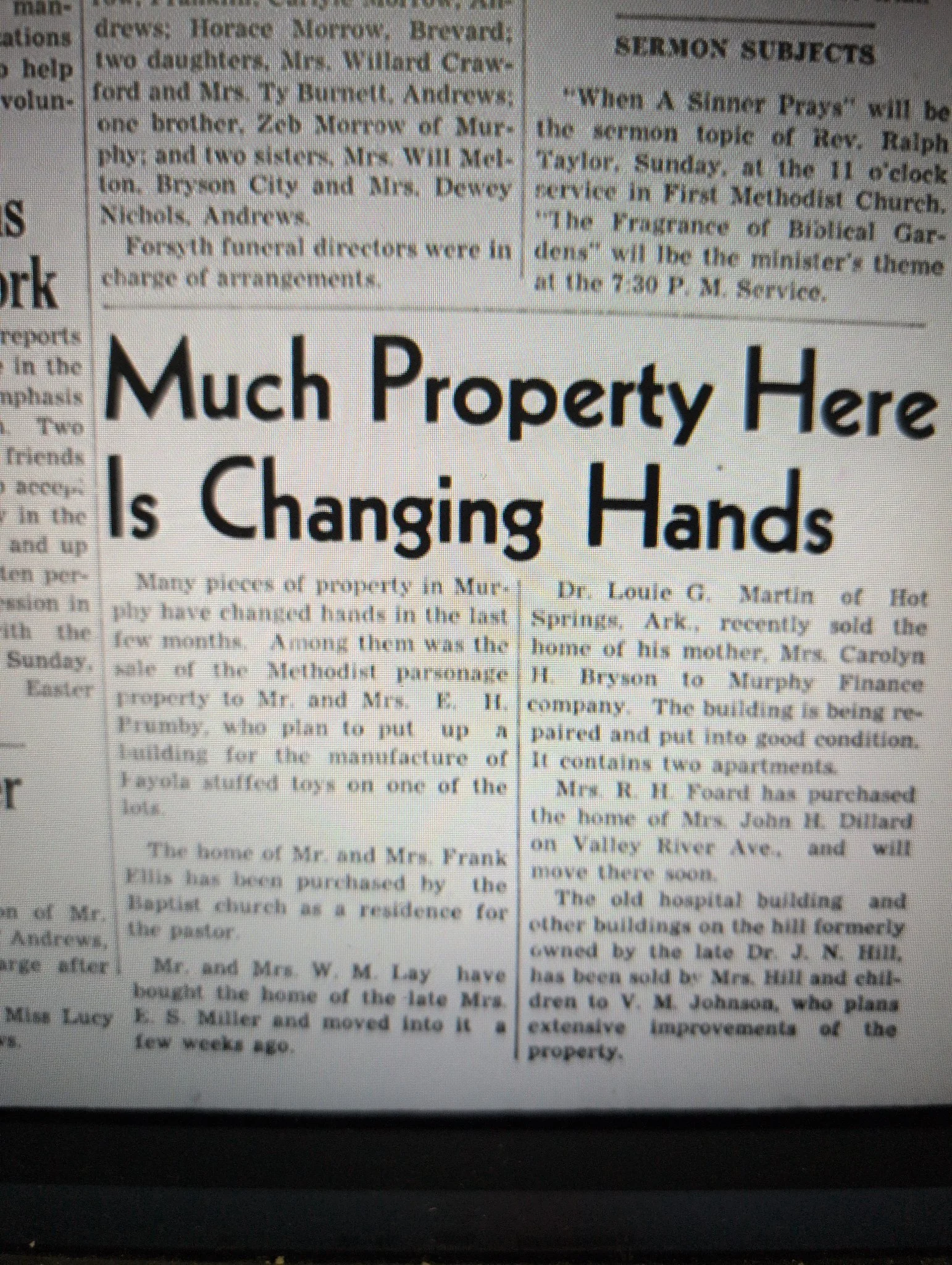
Much Property Here Is Changing Hands — Cherokee Scout, March 1946. The Methodist parsonage property sold to Mr. and Mrs. E. H. Brumby.
Mrs. Brumby — Mildred, a Hartwell, Georgia native, daughter of Charles P. Dodd — was the center of a certain kind of Murphy life. The record of her starts early: in 1946, the Scout's society column listed Mrs. E. H. Brumby among the guests at a bridge luncheon, tallies marked for every lady, prizes for high score and low — and the bingo prize to Mrs. Brumby. Through the late 1940s and early 1950s the Scout's society pages return to her name again and again: hostess of the Wednesday Bridge Club's dinner-bridge at her home, presiding at the Murphy Woman's Club, giving the club's Thanksgiving program in November 1950, the year the post office opened next door. In March 1954, the Scout's front page carried the worst kind of headline: "Mrs. Brumby Dies in Auto Accident." She was killed near Ocala, Florida, and Murphy read about it above the fold. E.H. Brumby lived on until July 9, 1976, dying in Gainesville, Georgia, remembered by the Asheville Citizen-Times as a "Murphy industrialist."
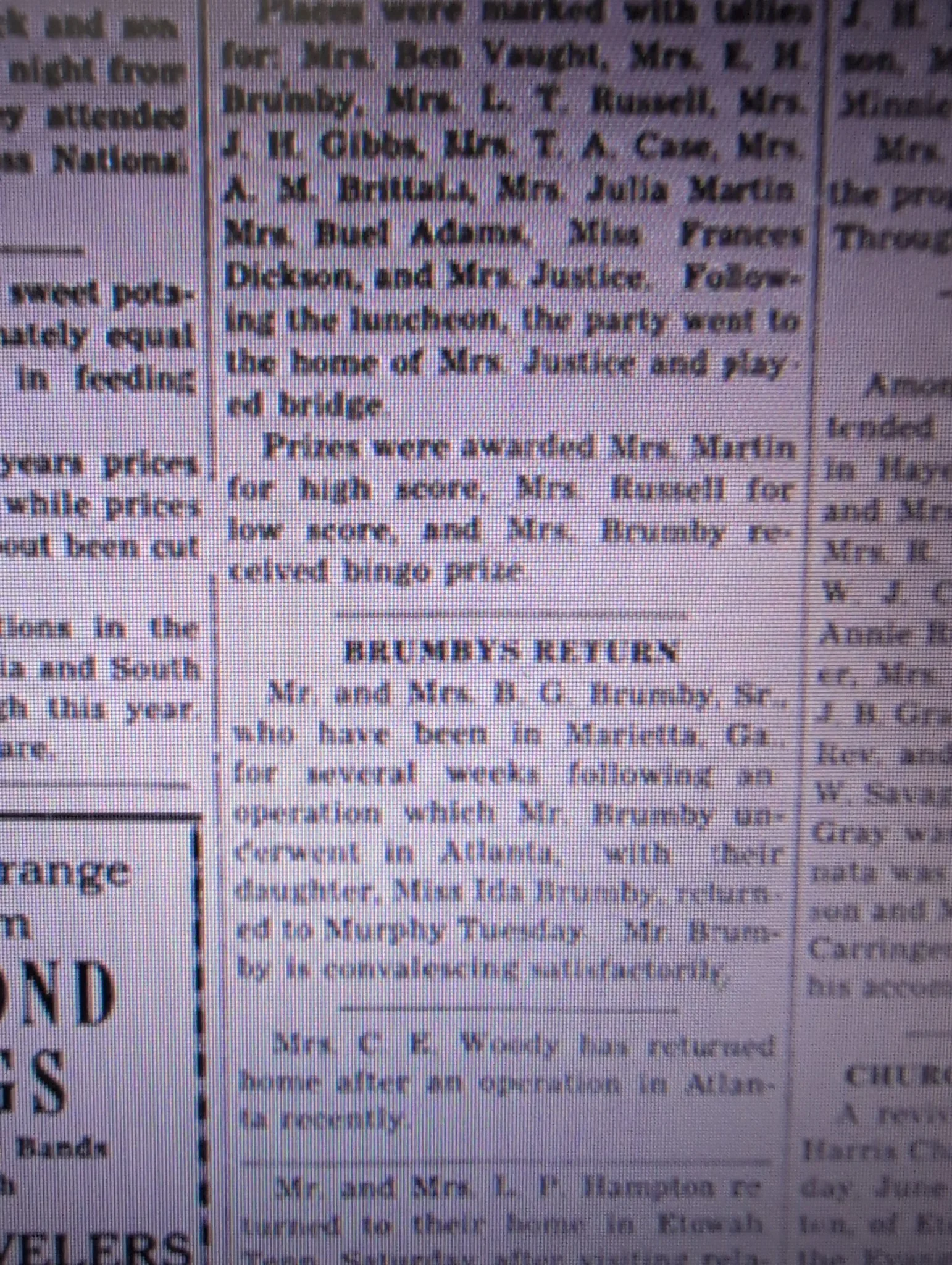
The Scout's society page, 1946: Mrs. E. H. Brumby at the bridge luncheon, and the Brumbys' return to Murphy.
The post office years
The building opened in March 1950 as Murphy's United States Post Office. The Scout marked the moment the way small towns did — in the advertisements. On March 23, 1950, the De Luxe Cleaners took out space to say "WELCOME To OUR NEW POST OFFICE AND ITS FORCE," and ten years later the Scout's "10 Years Ago" column looked back: "Murphy people are now getting their mail at the new post office on Hiwassee Ave." The postmaster in those first years was Joe E. Ray.
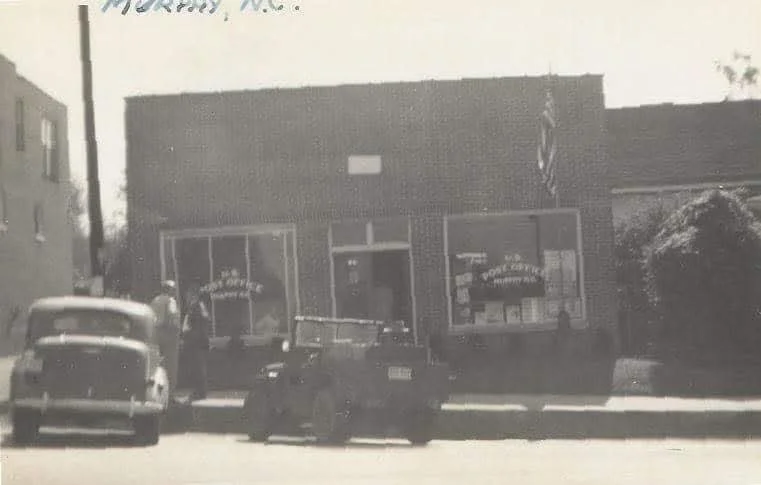
The building in its first life: U.S. POST OFFICE — MURPHY, N.C. lettered across the windows. Photograph, c. 1950s. Credit: Linda Fowler.
For a generation, this building was where Murphy's letters, packages, money orders, and Christmas cards passed through. It became the town's fixed point — the place you gave directions by. In September 1962, Howell's Super Market advertised salmon at 49 cents a can and hamburger at 39 cents a pound, and in the small print under the bananas gave its location the only way that mattered: "NEXT DOOR TO POST OFFICE IN MURPHY." A dozen years after the building opened, a business still located itself by standing next to it. As late as 1970, a Hiwassee Street rental ad and a shop called Lena's were still using the same landmark: next door to the post office.
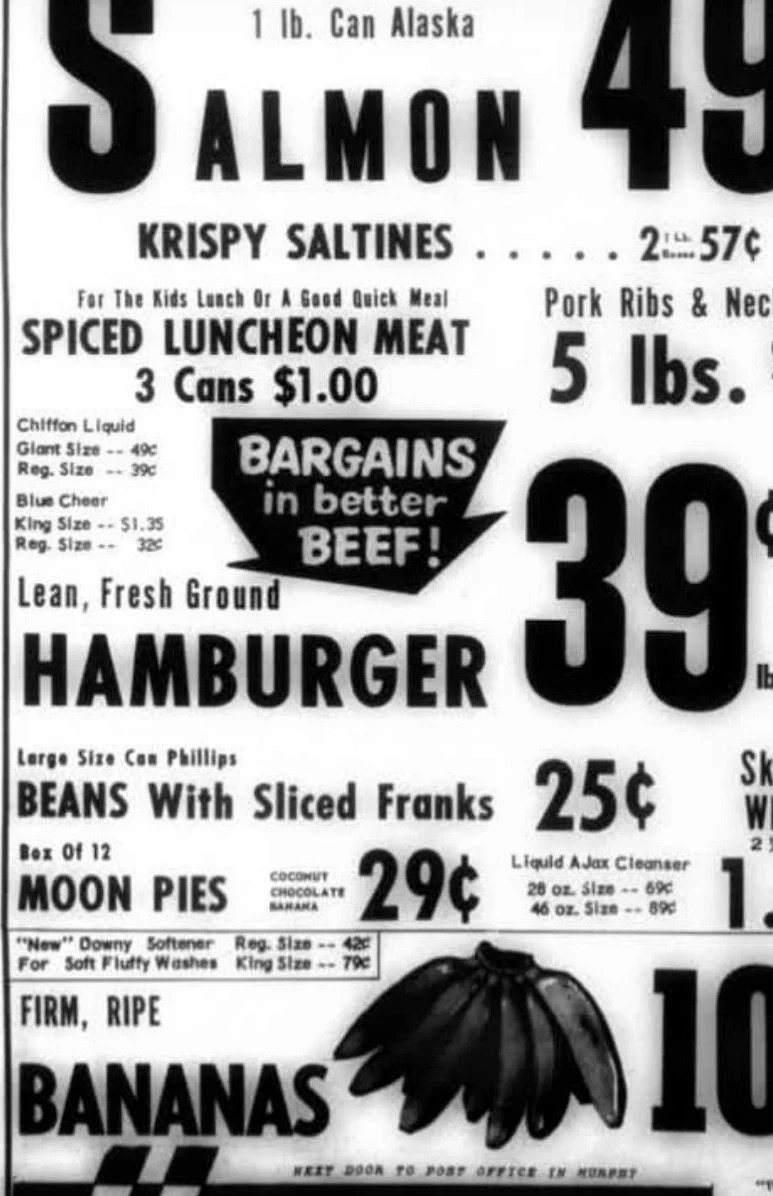
Howell's Super Market advertisement, Cherokee Scout, September 1962. The small print gives its location: NEXT DOOR TO POST OFFICE IN MURPHY.
The grocery years
In time the post office moved on, and the building began its second life as a grocery store. This chapter is the least documented and the most remembered. The paper trail thins here — no opening announcement has surfaced yet — but the people trail is strong. Murphy folks still alive remember walking to the store in this building, and remember it as a place you could get to on foot through the Blizzard of '93, when walking was the only way anything got done. A post office belongs to the whole town officially. A grocery belongs to it daily. By the accounts of the people who shopped there, this one did.
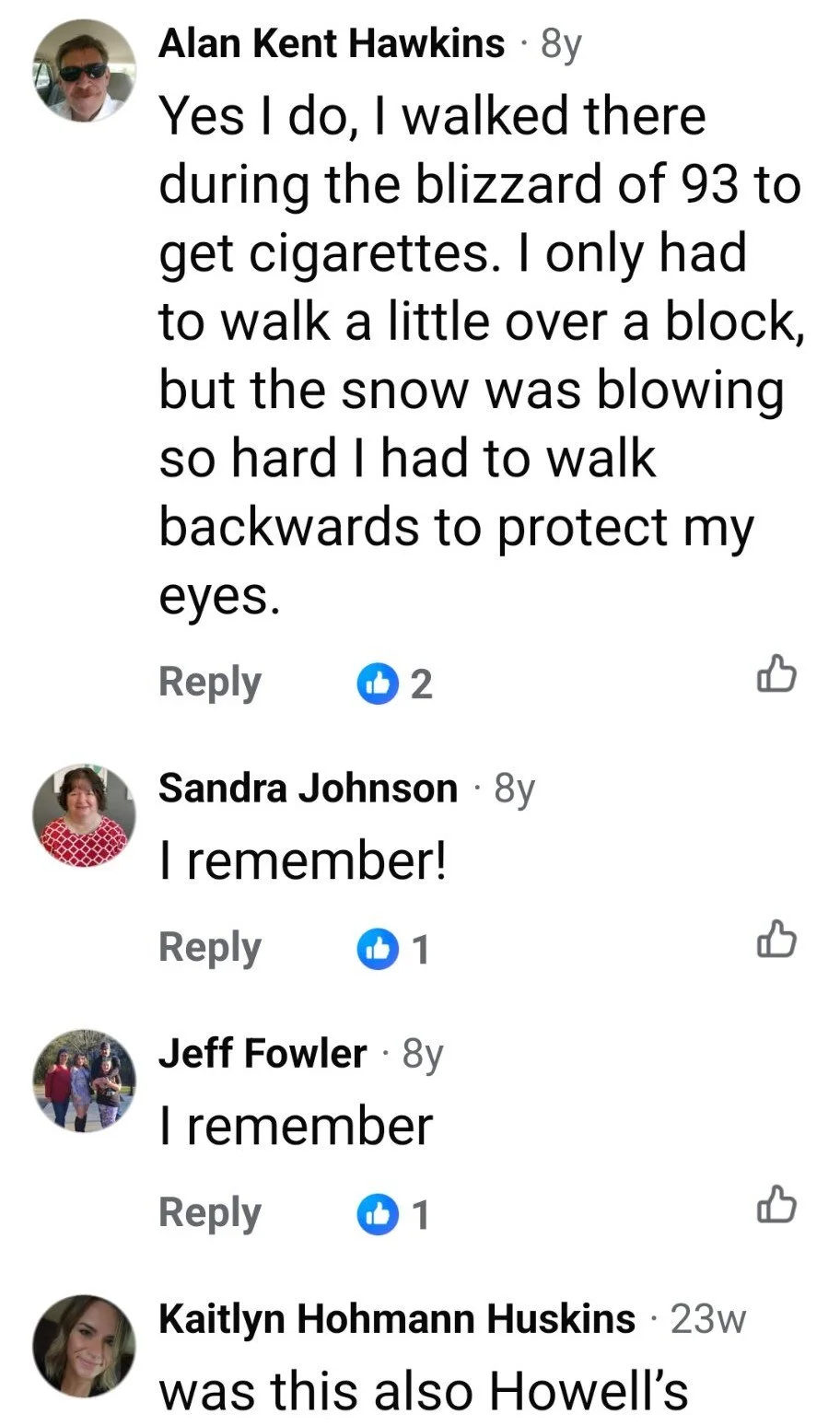
The grocery years live in memory: Murphy residents recalling the store in this building, including walking to it through the Blizzard of '93. Collected October 2026.
The Ballroom
The building's third life is the one it's living now. Today 51 Hiwassee Street is The Ballroom, an event venue owned by Kathleen Cousin and run by her family — the same family that has run Downtown Pizza Co. across the street since 2001, and whose kitchen caters the room. Everything catered here is, as the invoices say, A Downtown Pizza Co. Production.
The stained glass over the doors is this family's contribution to the building: Kathleen and her husband installed it, and the fleur-de-lis worked into the glass is deliberate — a Louisiana stamp from where the family came from before Murphy, set permanently over the door of a North Carolina landmark. The room has been renewed the way the Brumbys would probably recognize: steadily, by the people who own it. A renovation that began during COVID started with a new crystal chandelier; the carpet was replaced in 2024; the work, and the intention to keep preserving the place, continues.
And the building is still doing the job it has always done. In October 2026 the Cherokee Scout put this room on its front page two weeks running — the Town of Murphy's Volunteer Appreciation Dinner one week, and candidate events for both parties' hopefuls around it: a meet and greet, a town hall, a candidates' forum, all in the same room in the span of twelve days. Weddings, reunions — the Class of '76 came home here fifty years on — baby showers, seminars, health screenings. The mail doesn't come here anymore. The town still does.
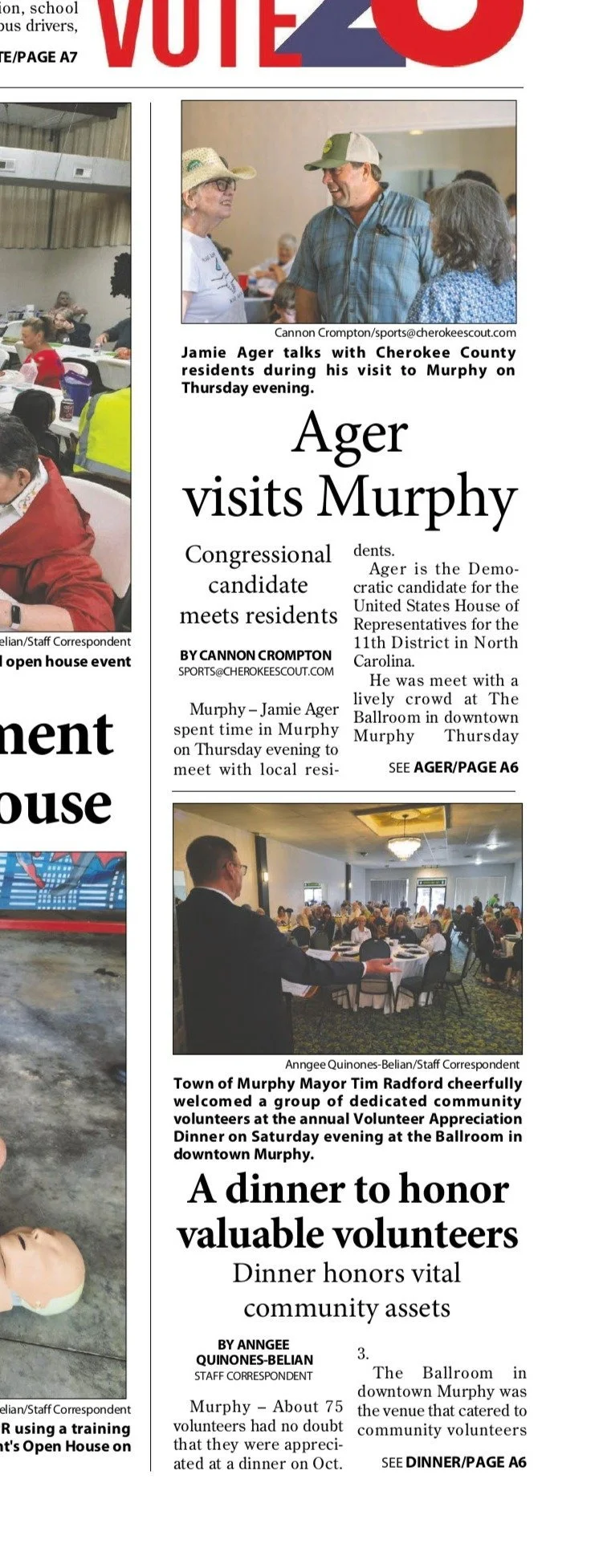
From the front page of the Cherokee Scout, October 2026 — a candidate's visit and the town's Volunteer Appreciation Dinner, both in this room.
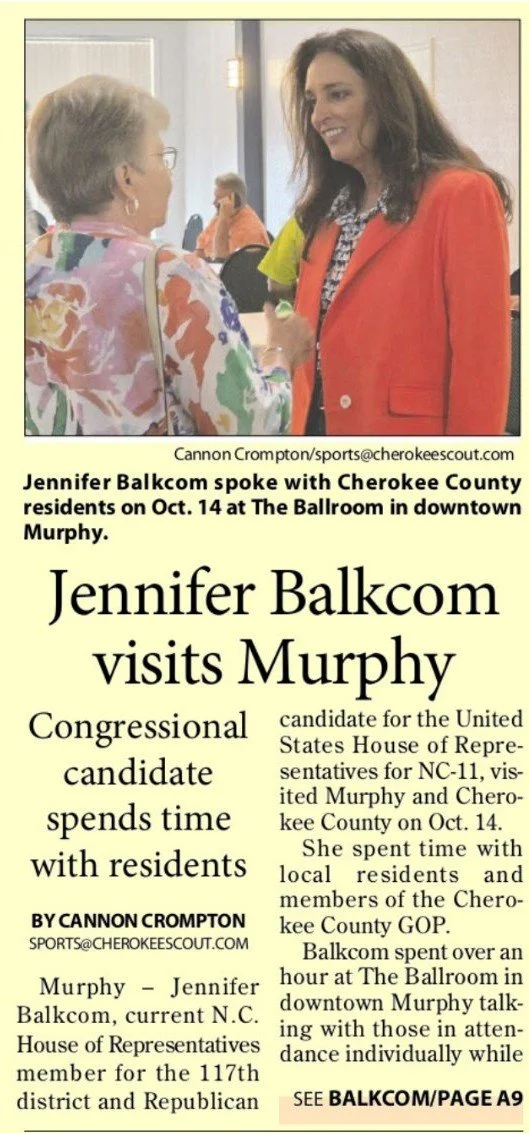
One week later, the same room led the paper again: a town hall at The Ballroom. Cherokee Scout, October 21, 2026.
What the record hasn't told us yet
An honest history says what it doesn't know. We don't yet know the grocery store's name or its exact years; that record is still being searched, in the Scout's archives at the North Carolina Digital Heritage Center and on microfilm at the Murphy Public Library. We know a Roland Glover Brumby came to Murphy in 1934 and, in the Asheville Times' words, "founded a textile mill here" — but exactly how he connects to Edward is still being untangled, and this history won't guess. The record has already corrected us once: early searching suggested Ida Brumby might be Edward's daughter, until the 1946 column itself showed her as B. G. Brumby Sr.'s daughter. Print beats guessing, every time. Some of what we believe about Mildred Brumby rests on newspaper indexes that still have to be verified against the original pages, and that reading is underway.
That's fitting, in a way. This building has outlasted every business in it, and it will outlast the current one. The archive we're building — clippings, photographs, dates, dead ends and all — are being kept so that whoever stands in this room fifty years from now can know what it was: a post office, a grocery, a ballroom, and always, the middle of Murphy.
Sources & verification notes
The clippings and photographs on this page are held in The Ballroom's own archive: the c. 1950s post office photograph (credit Linda Fowler); Howell's Super Market advertisement, Cherokee Scout, September 1962; the Cherokee Scout's society column and property column of 1946; the Cherokee Scout front pages of October 14 and October 21, 2026; and recollections of Murphy residents, collected October 2026.
Newspaper research draws on the Cherokee Scout archive at the North Carolina Digital Heritage Center (DigitalNC, via the Murphy Public Library) and on the Asheville Citizen-Times and The Asheville Times via newspapers.com. Key citations: De Luxe Cleaners' welcome advertisement, Cherokee Scout, March 23, 1950; "10 Years Ago" column, Cherokee Scout, March 31, 1960; Postmaster Joe E. Ray, Cherokee Scout, May 18, 1950; obituary of Mildred Dodd Brumby, Asheville Citizen-Times, March 8, 1954; "Mrs. Brumby Dies in Auto Accident," Cherokee Scout, March 11, 1954; fire item, The Asheville Times, March 20, 1952; "E. H. Brumby Announces For Assembly," Asheville Citizen-Times, March 11, 1970; obituary of Edward Hunt Brumby Sr., Asheville Citizen-Times, July 10, 1976; obituary of Roland Glover Brumby, The Asheville Times, January 31, 1959. Family accounts: interview notes from the son of E. H. Brumby, November 2, 2026, and the Cousin family's account of the stained glass and the Ballroom-era renovations.
Prepared November 3, 2026. The research continues, and this page will be updated as the archive's open questions close.